Monday, February 18, 2008

FW: Grand Challenges for Engineering

The American National academy of challenges has chosen 14 engineering
challenges for the 21st century.

http://www.engineeringchallenges.org/cms/8996/9221.aspx

------------ Institute For Infocomm Research - Disclaimer -------------This email is confidential and may be privileged. If you are not the intended recipient, please delete it and notify us immediately. Please do not copy or use it for any purpose, or disclose its contents to any other person. Thank you.--------------------------------------------------------

Tuesday, February 12, 2008

Farmer digging a toilet, unearths 2,000-yr-old well

Farmer digging a toilet, unearths 2,000-yr-old well

Well that Dahanu farmer Murlidhar Patil found dates back to the
Satavahan Dynasty that ruled Maharashtra from 40 BC to 220 AD; a
historian has confirmed find; Archaeological Survey of India to visit
site soon


Ram Parmar

All Dahanu farmer Murlidhar Patil had wanted when he started digging his
plot of land on Saturday, was a decent toilet block. So, when the
50-year-old's spade hit a peculiarly-shaped object, he dismissed it as a
lump of clay. However, his excitement began to steadily grow when the
'lump of clay' turned out to be a conical structure with several rings
around it.


Positive he had hit upon some treasure, an excited Patil immediately
contacted a history professor at the local college who confirmed that
the structure was a clay well that dated back to the Satavahan Dynasty
that ruled Maharashtra nearly 2,000 years ago.

The structure is now in the safe custody of a Dahanu college and a team
of archaeologists from Mumbai will visit the site shortly.

The 7-foot-high structure has seven rings, each at a distance of one
foot. The diameter of the largest ring is 32 inches which, when it
reaches the seventh inner ring, measures one inch, giving the structure
its conical shape. The structure has no base as even after digging 15
feet below, there was no sign of hard rocks.

Digging further, Patil also found water that was 2 feet deep and that
was sweet to taste.

When Patil, 50, first saw the structure, he tried to lift it but
couldn't as it was firmly embedded in the ground. He then contacted Prof
Prerna Raut, head of the history department at P L Shroff College,
Dahanu. The professor rushed to the site with her students. After
consulting her guide, Prof Dr Kishore Gaikwad, a senior history
professor at Mumbai University, Raut confirmed that the structure dated
back to the Satavahan Dynasty.

Murlidhar Patil with the ancient well he unearthed
According to eminent archaeologist Omkar Chavan, an identical structure
was found in Revdanda and Chowl (in Ratnagiri), where students of the
Deccan College, Pune, had gone on a college trip in 2006.

According to Raut, around seven such wells were found in the
Chinchani-Bandarali stretch (in Dahanu), which were mentioned in a book
written by the late historian Tatyasaheb Churi in 1945. Another such
well was also found by Moreshwar Mhatre while he was tilling his land in
1973.

A carbon dating on the structure will be done by the Archaeological
Survey of India (ASI), which will be sending a team to the site soon.

THE SATAVAHAN DYNASTY

The Satavahan Dynasty ruled Maharashtra from 40 BC to 220 AD and had its
seat at Paithan, located on the banks of the river Godavari.
Gautamiputra Satakarni was the most famous king of this dynasty, while
Sri Yajna Satakarni was its last king. The Satavahanas were able rulers
and lovers of architecture and literature. The Dynasty played an
important role in the social, economic, culture and political history of
Maharashtra.

--

http://www.fastmail.fm - Faster than the air-speed velocity of an
unladen european swallow
Monday, February 11, 2008

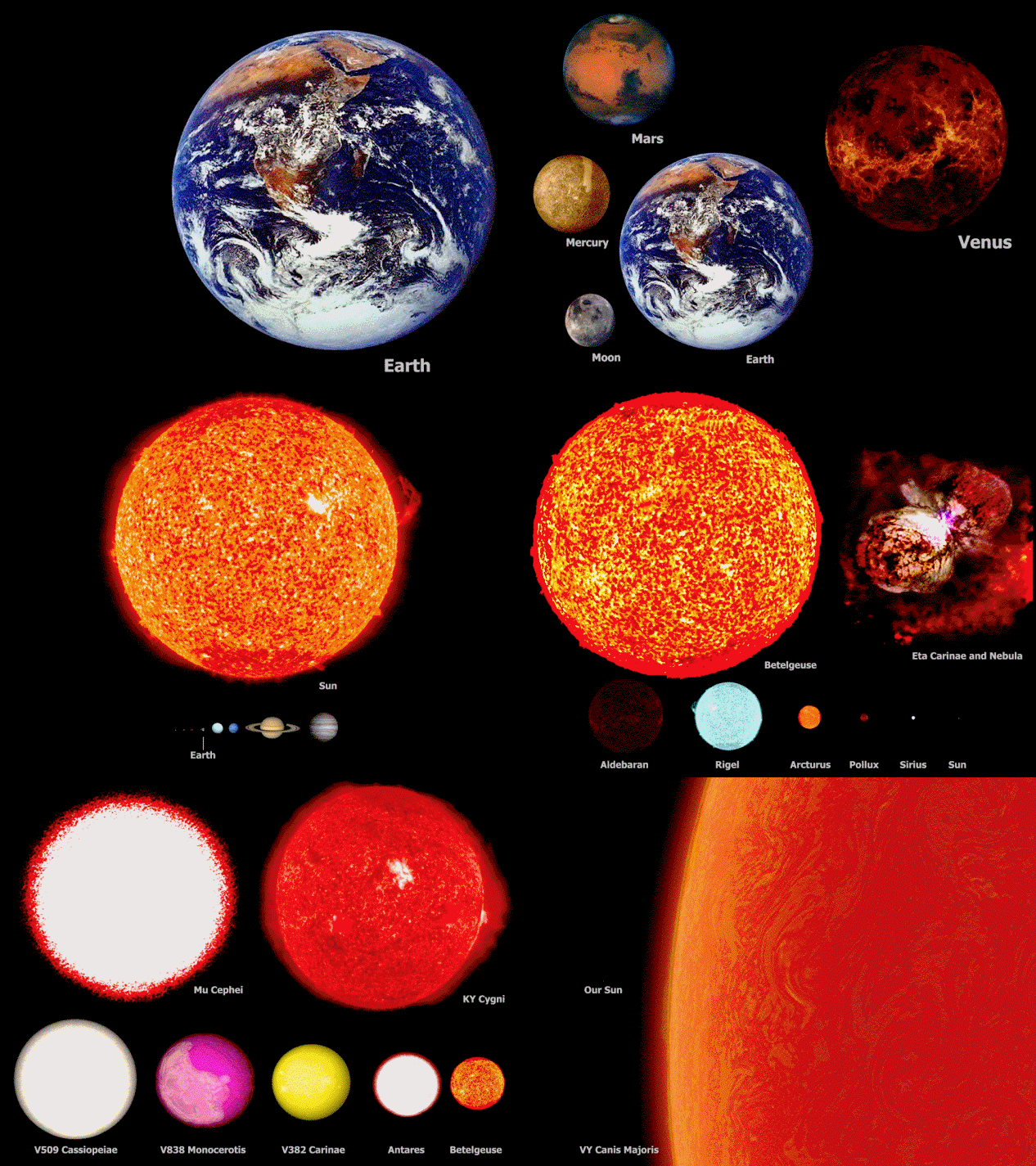
FW: Starry Perspective


This link (http://i51.photobucket.com/albums/f351/dabears1020/1202609635165.gif) is interesting, for the perspective it offers on dimensions of some known stars.


Hubble Collection to ponder over: http://hubblesite.org/gallery/album/entire_collection/


Friday, February 1, 2008

The Beauty of STATISTICS


http://www.viddler.com/player/723d3020/

GapMinder -- The world

World 2006 according to Gap Minder
http://www.gapminder.org/world/

Mathemagician Arthur Benjamin

Mathemagician Arthur Benjamin: http://www.ted.com/talks/view/id/199

From Ideas Worth Spreading
http://www.ted.com

Extraordinary presentation of data

See
http://balajiviswanathan.blogspot.com/2007/09/extrordinary-presentation-of-data.html

OR
http://www.youtube.com/v/hVimVzgtD6w  http://www.youtube.com/v/YpKbO6O3O3M   

COCONUT WATER: USAGE BENEFITS

Why Drink Coconut Water?


CocoWater is naturally:
  • Low in Carbs
  • 99% Fat Free
  • Low in sugars

Coconut Water contains organic compounds possessing healthy growth promoting properties that have been known to help -
  • Keep the body cool and at the proper temperature.
  • Orally re-hydrate your body, it is an all natural isotonic beverage.
  • Carry nutrients and oxygen to cells.
  • Naturally replenish your body's fluids after exercising.
  • Raise your metabolism.
  • Promote weight loss.
  • Boost your immune system.
  • Detoxify and fight viruses.
  • Cleanse your digestive tract.
  • Control diabetes.
  • Aid your body in fighting viruses that cause the flu, herpes, and AIDS.
  • Balance your PH and reduce risk of cancer.
  • Treat kidney and urethral stones.
  • Boost poor circulation.

Coconut Water -
The English name coconut, first mentioned in English print in 1555, comes from Spanish and Portugese word coco, which means "monkey face." Spanish and Portugese explorers found a resemblance to a monkey's face in the three round indented markings or "eyes" found at the base of the coconut. On the Nicobar Islands of the Indian Ocean, whole coconuts were used as currency for the purchace of goods until the early part of the twentieth century.

Coconuts are the fruit of the coconut palm, botanically known as cocos nucifera, with nucifera meaning "nut-bearing." The fruit-bearing palms are native to Malaysia, Polynesia and southern Asia, and are now also prolific in South America, India , the Pacific Islands , Hawaii and Florida. The light, fibrous husk allowed it to easily drift on the oceans to other areas to propagate. In Sanskrit, the coconut palm is known as kalpa vriksha, meaning "tree which gives all that is necessary for living," since nearly all parts of the tree can be used in some m anner or another. The coconut itself has many food uses, including milk, meat, sugar and oil as well as functioning as its own dish and cup. The husk was also burned for fuel by natives, but today a seed fibre called coir is taken from the husk and used to make brushes, mats, fishnets, and rope. A very potent fermented toddy or drink is also made from the coconut palm's sap. Coconut oil, a saturated fat made from dried coconut meat, is used for commercial frying and in candies and margarines, as well as in non-edible products such as soaps and cosmetics.

Although it takes up to a year for coconuts to mature, the trees bloom up to thirteen times a year, so fruit is constantly forming yielding a continuous harvest year-round. An average harvest from one tree runs about 60 coconuts, with some trees yielding three times that amount. The coconut's name is a bit of a misnomer, since it is botanically classified as a drupe and not a nut. It is the largest seed known.

If you've ever opened a fresh coconut, you will have seen the thin, opaque almost clear coconut juice or water which has a slight almond flavor. Contrary to popular belief, this is not the coconut milk. However, the water is consumed as a drink fresh from the coconut by many, and it can also be used in recipes.

Here are some more information about Coconut Water -
"It's a natural isotonic beverage, with the same level of electrolytic balance as we have in our blood. It's the fluid of life, so to speak." In fact, during the Pacific War of 1941-45, both sides in the conflict regularly used coconut water - siphoned directly from the nut - to give emergency plasma transfusions to wounded soldiers.

Most coconut water is still consumed fresh in tropical coastal areas - once exposed to air, the liquid rapidly loses most of its organoleptic and nutritional characteristics, and begins to ferment.
  • Coconut Water is More Nutritious than whole milk - Less fat and NO cholesterol.
  • Coconut Water is More Healthy than Orange Juice - Much lower calories.
  • Coconut Water is Better than processed baby milk - It contains lauric acid, which is present in human mother's milk.
  • Coconut water is naturally sterile - Water permeates though the filtering husk.
  • Coconut water is a universal donor - Its identical to human blood plasma.
  • Coconut Water is a Natural Isotonic Beverage - The same level we have in our blood.
  • Coconut water has saved lives in 3rd world countries thru Coconut IV.

"Coconut water is the very stuff of Nature, biologically Pure, full of Natural Sugars, Salts, and Vitamins to ward off fatigue and is the next wave of energy drinks BUT natural", according to Mortin Satin, Chielf of the United Nation's Food & Agriculture Organization.
Coconut water contains more potassium (at about 294 mg) than most sports drinks (117 mg) and most energy drinks.
  • Coconut water has less sodium (25mg) where sports drinks have around 41mg and energy drinks have about 200 mg.
  • Coconut water has 5mg of Natural Sugars where sports and energy drinks range from 10-25mg of Altered Sugars.
  • Coconut water is very high in Chloride at 118mg, compared to sports drinks at about 39mg.
  • Data is based on a 100ml drink
==========================================================